LET’S HELP
EVERY
CHILD READ
AND DO MATH.
Today, millions of children across India — and the wider global south — are engaged in an invisible struggle to reach the level of reading and math competency their grade demands. AXL (Assisted Language and Math Learning) is a system-led, AI-powered, teacher-supported initiative that helps children close that gap, through joyful, personalised practice built into the school day.
AXL is developed by EkStep Foundation in collaboration with AI4Bharat, and is now active, piloting, or in discussion across 11 states — reaching close to 16,000 schools across the country.
Why AXL
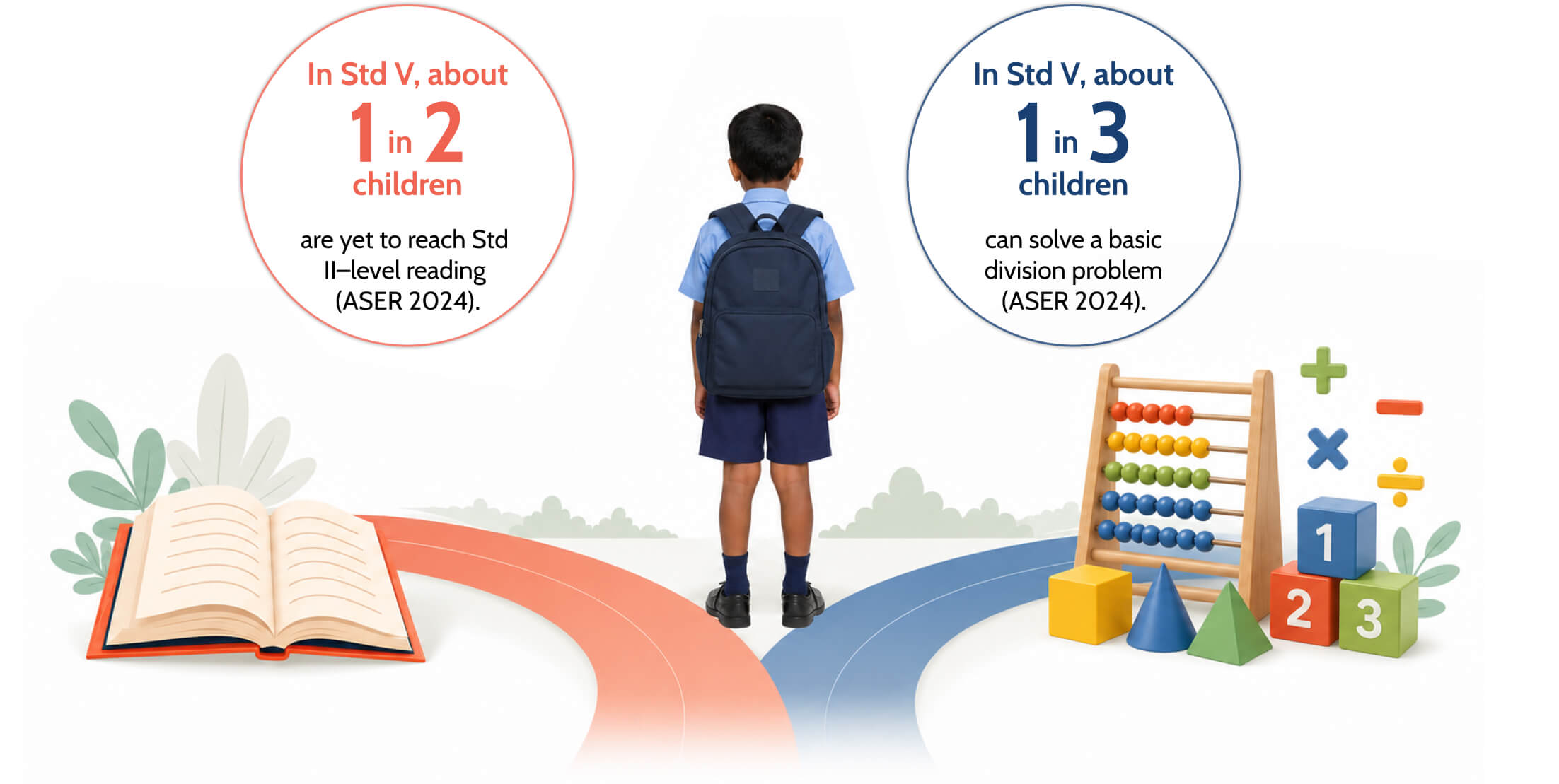
National data shows why targeted support for Foundational Literacy and Numeracy (FLN) is urgent. While reading and math outcomes do improve with grade, large numbers of children are still left behind along the way:

Why does being enrolled in school not always translate into learning?
Large mixed classrooms, syllabus pressure, uneven home environments all play a role. Teachers frequently have too much to do and personalized attention is impossible within the current system. Children that are not able to keep up with the class often get bullied, suffer anxiety and are likely to drop out after a few years of compounding gaps.
The Thesis of Practice
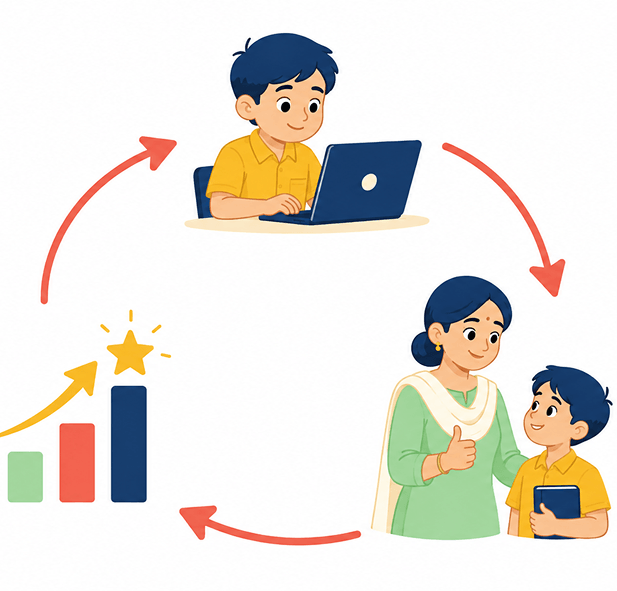
Children who are behind grade level don’t need more instruction — they need more and better opportunities to practice. This is the thesis AXL is built on: foundational skills improve through targeted, repeated, personalised practice in a judgment-free environment. Children learn through making their own mistakes and correcting those mistakes through deliberate, abundant, personalized practice. This doesn’t need more of the same classroom instruction or more remedial hours or added teacher strength. AXL, co-created over three years, provides such practice opportunities through a structured school environment or through practice at home, augmenting the current system rather than replacing it.
Rigor and Rhythm
Central to this thesis is the Rigour and Rhythm of Practice - the recognition that only continuous, disciplined practice, sustained over time, produces observable learning outcomes. AXL’s focus is to bring a “package of practice” - an evolving set of tools that institutionalize this rigour and rhythm within the school system rather than leaving it to chance. These include AXL itself, but also, teacher orientation and training, a timetable-ready practice mechanism and assessment tools. Alongside these, it includes rhythms of communication, protocols and conversations that embed practice as a habit rather than a one-off intervention. This combination is what ultimately leads to outcomes.
What is AXL
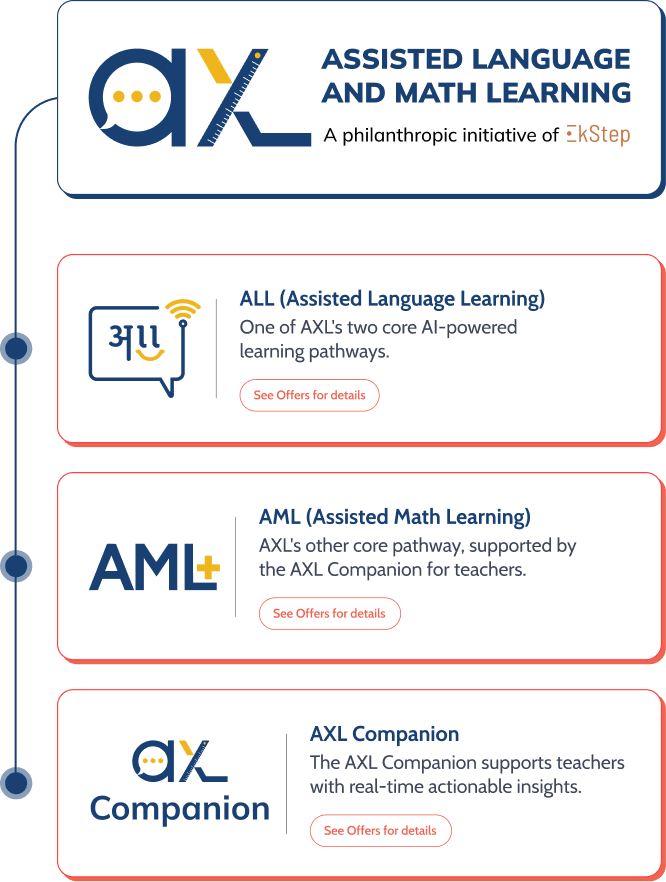
AXL is a system-led, AI-powered, teacher-supported technology that helps children read and do math. It runs as part of the regular school system: children use AXL in their school computer lab (or on shared devices) for a set number of periods each week.
AXL can also be used at home through a parent’s phone, tablet or computer.
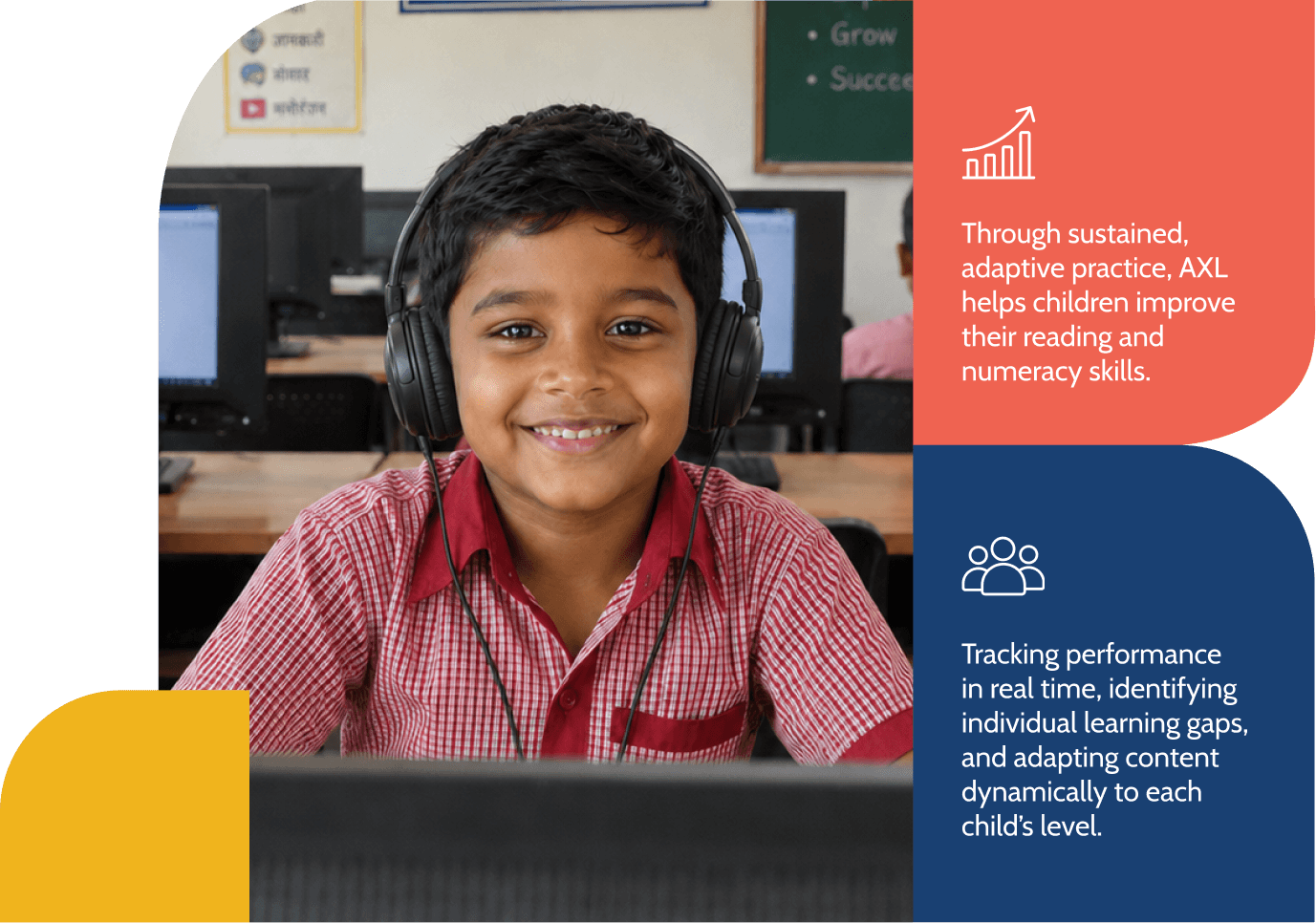
- Through sustained, adaptive practice, AXL helps children improve their reading and numeracy skills.
- Tracking performance in real time, identifying individual learning gaps, and adapting content dynamically to each child’s level.
The Components of AXL
Key Features

Safe space, free of judgment
No comparison, no judgment, no pressure, no fear of failure.

Abundant, joyful, adaptive practice
Milestone-based activities that keep children motivated to do more.

System-led, embedded in the existing ecosystem
Timetabled into the school day, run by teachers as facilitators, not as a parallel or after-school programme.

AI at the core
Precision diagnostics identify exactly what a child is struggling with (e.g. a specific syllable, or a specific math misconception like not understanding carry), not just a difficulty level.
What AXL Provides (Sovereign Model / DPI)
AXL is built and offered as Digital Public Infrastructure (DPI) — designed so that states and systems retain full ownership and control of their own data and deployment:

Complete data sovereignty
for the implementing state or system.

Plug-and-play deployment
into existing school infrastructure.

Low resource use and operations
works in low-connectivity environments and on basic devices.

Robust and scalable
proven from single-district pilots to state-wide rollout.

Flexible, configurable architecture
that can be adapted to local languages and curricula.
Underneath, AXL is powered by AI4Bharat’s Dhruva infrastructure, hosted at IIT Madras, which provides world-class multilingual Automatic Speech Recognition (ASR), Text-to-Speech (TTS), Optical Character Recognition (OCR), and Machine Translation — all running on dedicated GPU infrastructure. These capabilities combine with AI-driven learner profiling, adaptive learning models, and telemetry to support both cloud and on-premise deployment.
The Role of
Learning Science
AXL’s approach is grounded in learning science and neuroscience, not just engagement design. Through a research partnership with the Centre for Neuroscience, Indian Institute of Science (IISc) Bangalore, AXL is anchoring its practice model in the latest neuroscientific understanding of how children learn to read — insights that directly shape how the programme evolves.
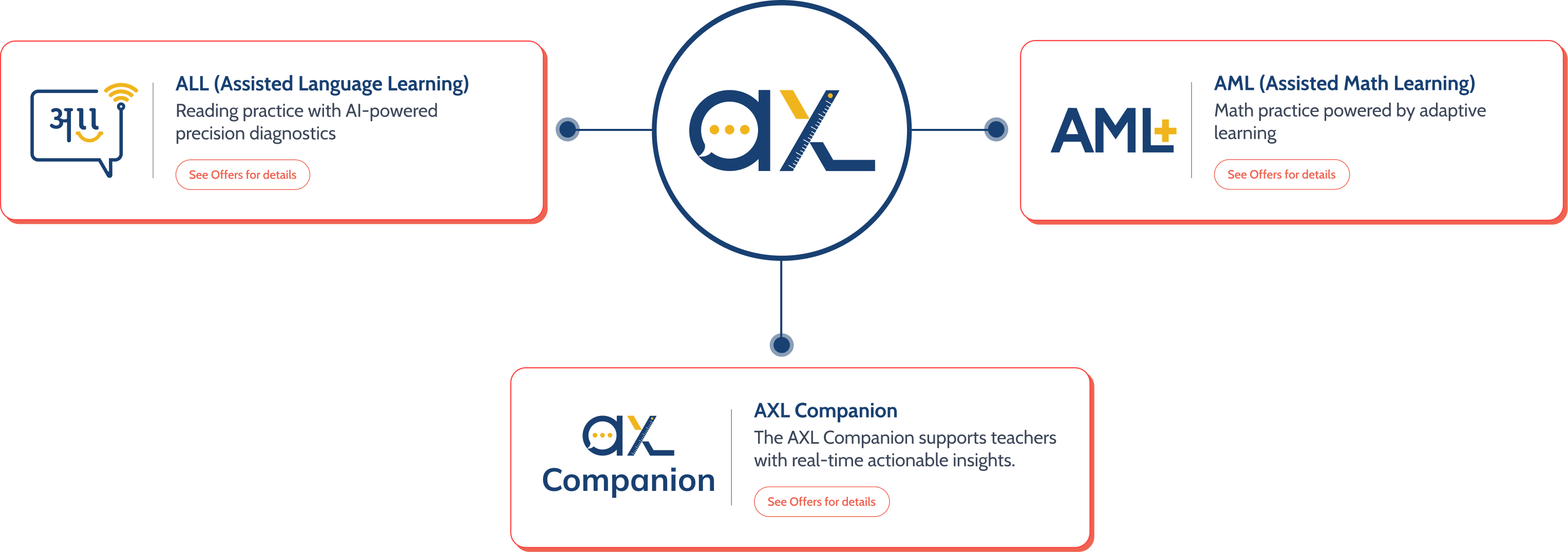
On the math side, AML doesn’t simply make a problem easier when a child answers incorrectly — that is personalisation of difficulty. AML personalises through precision: it uses a structured catalogue of misconceptions and error types, built from years of student response data, to identify exactly what went wrong (for example, forgetting to carry, misplacing a zero, or an incorrect order of operations). We call this Teaching at the Right Step (TaRS) — a level of surgical precision no classroom teacher, however skilled, can deliver simultaneously to 40 children.