Partnerships
A shared vision for education
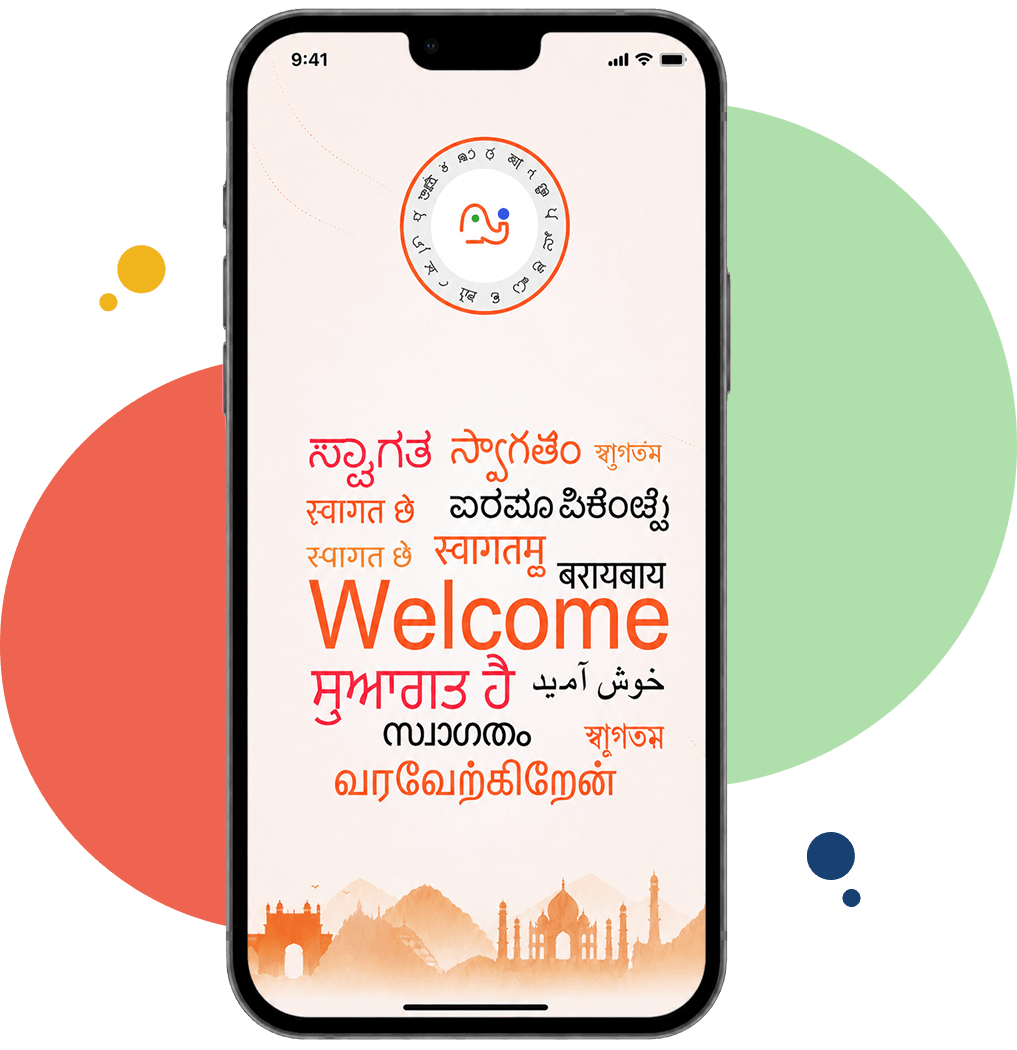
The Ministry of Education and the AI Centre Of Excellence for Education PMU recently convened a strategic conclave to shape the next phase of India’s foundational learning agenda. The conclave established broad alignment around the role of Digital Public Infrastructure (DPI) in enabling foundational learning at scale.
AXL and IISc


Improving literacy has been a national priority in India for decades, yet it remains one of the country’s most stubborn challenges. Part of the reason is that, despite how universal reading is, we still understand surprisingly little about how it actually happens in a child’s brain. Learning to read means mastering letter shapes, letter names, the sounds they map to, and ultimately the meanings of whole words and sentences — a transformation that reshapes the brain in ways science is only beginning to trace. When a child struggles, we often cannot tell which stage of that journey they are stuck at, or which underlying mechanism to target to help them move forward. It is, as the partnership’s founders put it, akin to troubleshooting a smartphone with no knowledge of its internal components — reduced to guesswork rather than diagnosis.
The collaboration between the Indian Institute of Science (IISc) and EkStep Foundation was created to close exactly this gap. It rests on a shared conviction: that literacy at scale in India can be achieved not through assumption or convention, but through a deeper neuroscientific understanding of reading — and by translating that understanding into interventions that work in real classrooms. The partnership brings together two organisations that each spent roughly a decade building deep, complementary expertise. At IISc, the Vision Lab, led by Prof. S.P. Arun at the Centre for Neuroscience, has built a sustained body of research into the neuroscience of reading through rigorous experimentation with both adults and children. EkStep, for its part, brings over ten years of experience designing and enabling large-scale foundational learning within India’s public education systems — most recently through AXL, its AI-powered literacy and numeracy initiative. Neither could achieve the goal alone: the Vision Lab’s insights needed a partner able to test them across many schools and work with governments to implement what works, and EkStep’s work at scale needed a research partner able to uncover the cognitive factors that truly drive reading.

The impact of bringing these two capabilities together is significant. Rather than relying on intuition, AXL’s learning tasks can now be shaped by the science of how children actually learn to read — and every design decision can be tested against evidence rather than assumption. As EkStep’s COO Jagadish Babu notes, when a programme works at national scale, small assumptions can affect millions of children; grounding the work in neuroscience lets the partnership replace those assumptions with evidence about what genuinely moves the needle. The collaboration aims to discover new cognitive and neural factors that shape a child’s path to fluent reading, verify that these hold at scale, and develop validated interventions that accelerate progress for children who are struggling — before extending the same evidence- driven approach from literacy to numeracy.
Ultimately, the IISc–EkStep partnership is a long-term commitment to bridging a persistent divide between rigorous academic research and large-scale public-education impact. Supported by philanthropic funding from Rohini Nilekani, it aims to lay the groundwork for evidence-driven innovation in education that is rooted in Indian realities — so that the goal of every child attaining foundational literacy and numeracy rests on science rather than guesswork. (For more on the partnership’s origins and aims, see the full IISc–EkStep announcement.)
AXL and Bodhan
AXL’s partner on the frontier of AI-in-education research is Bodhan AI — formally, the IITM Bodhan-AI Foundation, a Centre of Excellence (CoE) in AI for Education incorporated in October 2025 and housed at IIT Madras. Bodhan is building the Bharat EduAI Stack: an open, layered public AI infrastructure for education spanning foundational research, core AI models (ASR, TTS, OCR, reasoning, diagnostics), infrastructure, applications, and last-mile government delivery — aimed at bringing personalised teaching, infinite practice, and continuous feedback to learners in every Indian language, at population scale.
EkStep Foundation is one of Bodhan’s founding partners and collaborators, alongside Sarvam AI and Central Square Foundation. AXL’s AI-based precision diagnostics — the same technology that pinpoints exactly which syllables a child finds unfamiliar and personalises ALL’s practice — are featured by Bodhan as a “ready today” example of what AI can already deliver in primary education. AXL also appears among the Centre’s flagship technical workstreams as it builds toward scale.
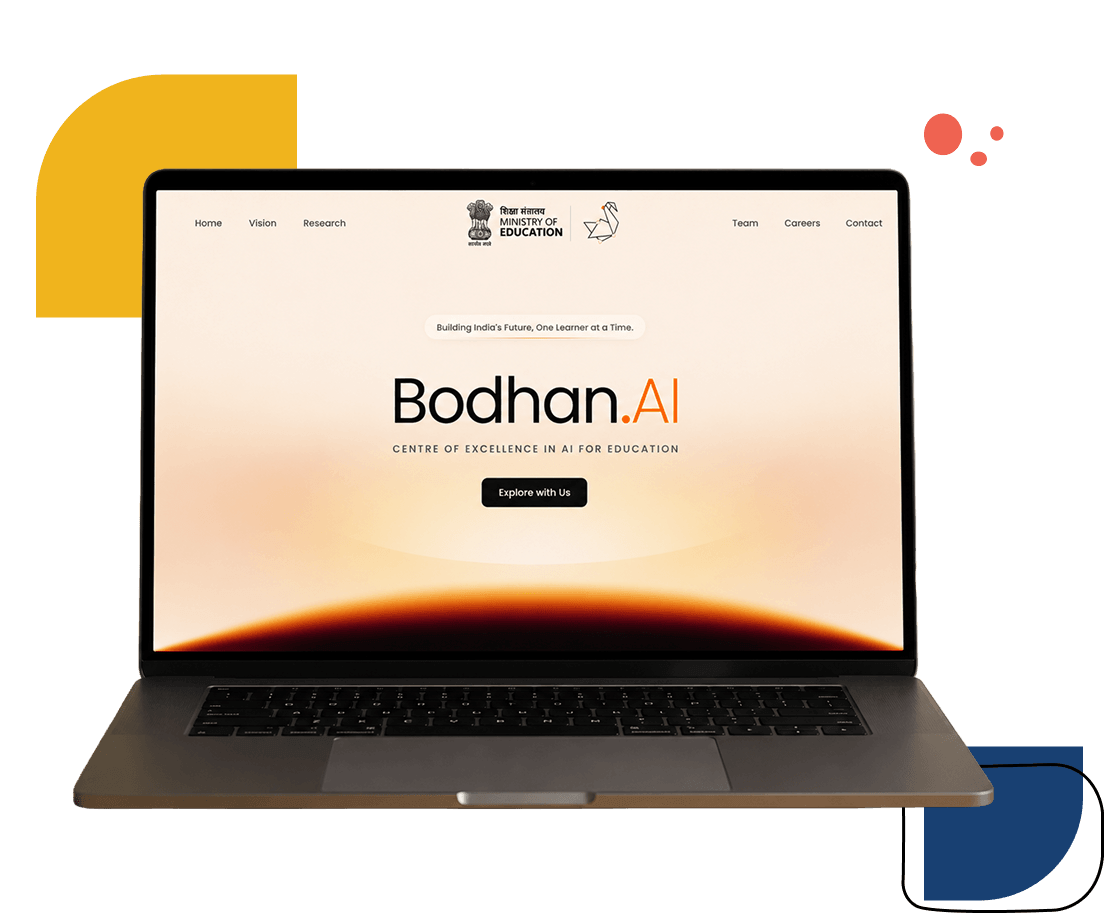
Bodhan’s core leadership and faculty are based at IIT Madras, including Prof. Mitesh Khapra, Dr. Suman Kundu, Prof. Nandan Sudarsanam, and a wider team of researchers, engineers, and educationalists.
AI4Bharat and IIT Madras
AXL is built in collaboration with AI4Bharat, whose foundational language AI models were established through EkStep’s philanthropic investment in 2019 — a contribution that continues to power AXL’s impact today. AXL runs on AI4Bharat’s Dhruva infrastructure, hosted at IIT Madras, on dedicated GPU infrastructure.
Through the AI Centre of Excellence in Education at IIT Madras, AXL also contributes to and benefits from the development of AI-based tools spanning every dimension of a child’s education journey, with access to best-in-class models and research.